Animation as a form of art has been around longer than most people expect it to have been. The descendants of animation date back over 4,000 years ago to ancient Egyptian burial chambers in which each frame of animation was drawn side by side. If you were to take these images and stack them one atop the other, you would end up with what is possibly the first, albeit crude, animation ever created.

Over the years, animation has expanded vastly from just simple silhouettes drawn on the walls of burial chambers, adding more and more detail and colour to the images as it evolves. 1833 was the first year humans started to create animations as we know them today, executed through the use of a “stroboscopic” effect.
The easiest way to visualise and understand a stroboscopic effect is to imagine the propellers of a plane spinning quickly and as you look at them, you can almost make out each blade slowly rotating backwards. Mimicking this by taking a piece of paper, blocking your vision of most of it and spinning it very quickly results in you only seeing a single frame of animation as it reaches your viewport before it is quickly replaced by the next. This results in what is essentially the first ever type of animation.

Since 1833, animation has greatly improved and advanced. New techniques have been toyed with and expanded upon which have evolved over time to what we know and love today. One of the most iconic examples of the earlier days of animation is “Steamboat Willie”, created by Walt Disney in 1928 which depicts the predecessor to Micky Mouse on a steamboat. This was one of the first times sound was added alongside an animation to add an extra layer of realism.
Disney didn’t stop there. In 1937, not long after Steamboat Willie shot to fame, the first feature length animated film “Snow White and the Seven Dwarfs” released. The most noticeable difference to come of the evolution is the addition of colour. This era of animation is what we now consider to be the grandfather of modern animation – without Walt Disney’s talents bringing animation to the mainstream, it might never have gained the traction that made it so popular.
Over the course of the next 60 years, animation greatly evolves to add more detail. More frames of animation were being added to create a smoother flow, more depth of colour was being added, shading techniques were used to create the illusion of 3D imagery. With all of the new additions, animations were becoming ever more advanced and lifelike. Human characters began to look like actual humans.

And along came 3D animation. Brewing in the background since 1972, 3D animation has been toyed and experimented with. New techniques were tried and tested to see how viable they might be for use on a larger scale. Ed Catmull, who we now know as one of the founders of Pixar Studios, created what we assume to be the very first 3D animation ever while studying computer science at the University of Utah.
But it wasn’t until 1995 that 3D animation was used in film. Toy Story is to 3D animation what Snow White is to 2D – the very first time it was ever used in a feature length film. Instead of drawing each frame, you now took a model and manipulated it inside of a 3D environment, marking each change as a new frame.

Models started out as very, very crude objects that somewhat resembled their finished character. This is the “skeleton” of a model, functionally the same as our skeletons. They allow 3D animators to control and manipulate the model frame by frame. As the animation develops over time, so does the detail of the model; starting with the most important feature, the face, details are added to a model to allow the animator to animate each aspect such as facial expressions and eye movement.
But 3D animation didn’t stop here. Films started to use 3D animation outside of just cartoon-like characters; films such as The Matrix started cropping up using animation in the form of Computer Generated Imagery (CGI). Animation was now used to create effects and shots that would otherwise be impossible.
By the early 2000s, animation was used for everything. Advertisements, films, television, games, science, education. You name it, animation likely has an applicable use. Films were getting more and more advanced techniques of animation, employing new technologies such as Motion Capture (MoCap) to better mimic human movements.
All the while the film and television industry have being getting their money’s worth of animation, the games industry has been lingering in the background. In 1972, along came the first commercially successful and widespread video-game “Pong”. Pong’s visuals are extremely bare-bones (in that they are only white lines), but the game still required animation. For the player(s) to be able to play the game, they needed to be able to see the ball and paddles, and as such, they were animated, though not using the conventional techniques used by other media of the time. Instead of having frames of animation or models moving around a 3D space, Pong was simply just the television drawing white pixels in place.
The first real use of animation as a way to bring life to a character in a scene was around the early 80s. The most iconic of these games is Super Mario Bros., a well known 2D platformer for the NES. The main character, Mario, was animated with 41 unique frames of animation per colour scheme. Despite having 7 different visual variants, there is only one set of sprites due to the technical limitations of the platform, and as such the creators of the game engineered some trickery to get all sprites, not just Mario, to be reusable simply with a colour change.

As game console technology advanced, so did the visuals and animations used in them. The first 3D game, Wolfenstein 3D, used many more sprites and unique variations, but still limited by the technology of the time was restricted to 2D characters.

Comparing 1992’s game characters against Disney’s 1937 film “Snow White and the Seven Dwarfs” might raise the question of “why so vastly different in quality?”. The answer to that question boils down to something very simple. If I asked you to make a cake, but you had to go out and gather the ingredients yourself, it’d take you far longer to make than if I were to just hand you the ingredients.
The same is applicable to digital animation – when used in film and television, animations are “pre-rendered”, meaning a computer somewhere in the world has been tasked to draw each frame, working out all the details of the lighting, particle effects etc. ahead of the time. When the film is released, all you need to do is play back each of those frames like a flipbook.
On the other hand, a computer game console or computer must compute all of those minute details themselves. With characters being able to move freely around a scene, you cannot simply pre-render what they are going to do otherwise you’d just be creating a film. As such, the details in said scene need to be much, much simpler for the computer to be able to render it in real time.
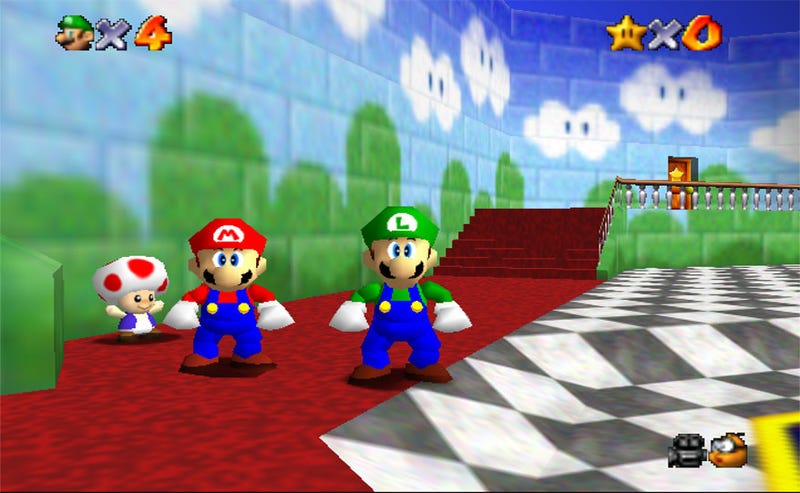
But it didn’t stop there. It kept going, and going, and going. Games such as “Super Mario 64” using polygonal models (true 3D) were just around the corner and brought with them some much more true to life visuals. Not being limited to two dimensions, the detail of characters skyrocketed in next to no time.
Animation is used in more than just films and games. Everything from television adverts to medical science uses. The evolution of technology alongside it has propelled the speed of creating animations to the point that render farms (large buildings full of computer hardware dedicated to rendering) are capable of completing what once was a month’s worth of work in just a few hours. But with greater graphical fidelity comes the cost of larger file sizes for models and environments. Thankfully, the end result of animated footage is tied to the resolution of the rendering and as such still tends to be reasonably small.
In what seemed like the blink of an eye, animation had gone from drawings on a wall to 3D models of people running around their own worlds. Animation hasn’t shown any signs of slowing down and will likely never die.
 Will Monk - 3D Animation